3.1. Organisation and its goals
A successful organisation is made up of committed people working for a common goal with ownership to complete their roles and responsibilities in timely manner (stakeholders). It is the responsibility of the management to create the eco system for these stakeholders to function with absolute clarity in the process and their roles.
The key stakeholders in a typical development project are;
- Design
- Approvals (including SEZ)
- Planning / Organising (Contracting & Procurement)
- Finance
- Execution
- Business Development & Marketing
- Operations (Fit-out & Facility Management)
While the above looks linear, in reality they have huge inter dependencies and the learnings flow from bottom to top. Each of this functional department cannot function in isolation without inputs and seamless functioning of others. Any delay in functioning of one of these would severely affect the performance of the others. It is like an orchestra where each of the instruments need to play its part in a pre-defined sequence and to get all of the notes in the right order.
As responsible members of the Development Team, you need to be aware of the functioning and criticality of all the other stakeholders of the project and how your operational actions would help or severely hinder the performance of other departments.
3.2. Organisation structure
The organisation structure has been created in a way that it shall facilitate the stakeholders to achieve the goals for their respective department. The goals of the Construction department shall be delivering the project, as per the schedule and within the budget within the underlying framework of quality and safety.
Since every action of the construction department has direct or indirect impact on the schedule, budget, quality and safety, the constituents / contributors to this activity have to be agile and vigilant. Being agile and vigilant here means planning, planning and planning. If every activity is dissected and made into logical steps and planned properly with resources required for the same, there are good possibilities that the same shall be completed successfully.
The above is possible only when we have;
(a) lean organisation
(b) clear processes
(c) well defined roles and responsibilities.
The organisation structure can be decided only when we have our overall strategy in place. There are modern theories and thought processes defining what & how much one undertakes as an organisation and what all should be contracted. This is about core competencies. As Phoenix, we are good at (a) identifying suitable land, (b) conceptualising the project, (c) arranging cost effective financing and (d) marketing the project. This means, as Phoenix we are conscious of the decision that we shall not be undertaking any aspect of construction and would leave the same to someone who is good at it viz. nationally and internationally reputed General Contractors.
Our first decision in this regard is, all our projects shall be executed through a competent General Contractor.
The next is how do we contract the works.
- The desired method is a Lump Sum design & build contract, based on our concept and specification. However, this has risk and can be very costly it also reduces the scope of changes / customisation to practically zero.
- The second is re-measurable item rate contract and
- The third option is Nominated sub-contracts under the GC management.
These have been detailed more in the Contract Strategy section. Given the complexities involved we have narrowed our choices to General Contractor undertaking the works which he is specialising as re-measurable item rate contract and the remaining to be awarded as the NSC.
With the above strategy, the roles of the construction department of Phoenix is limited to (a)Facilitation (b) Validation and (c) Approval.
The organisation structure for the development works is given as Appendix 2.1. This has been designed keeping the above arguments in view.
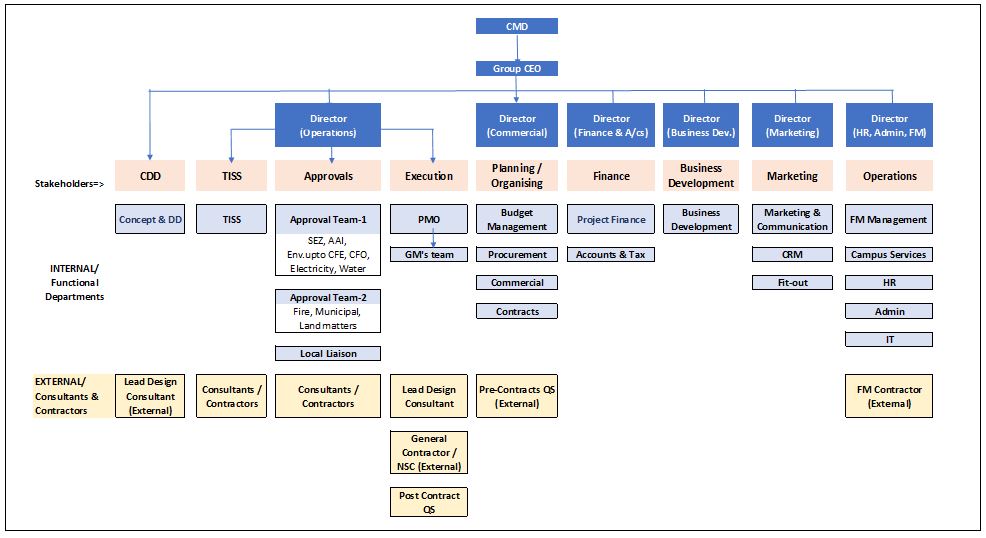
Functionally, following departments have been created for management of the development works;