Tender packages are set of documents stitched together and issued to shortlisted contractors to understand the scope and quote for the same. Creation of Tender package is like making a sculpture out of stone, and it takes shape over various stages. The more clarity is brought in the Tender; the pricing will be accurate. Imagine if the description of an item is not adequately detailed, the Bidder will assume the missing information or gaps in a most conservative manner resulting in the higher quoted rate or leave it out from the scope. The more detailed, simple language and clear drafting of the Tender is paramount to achieving perfect price quote for the Work.
Rule 6.27
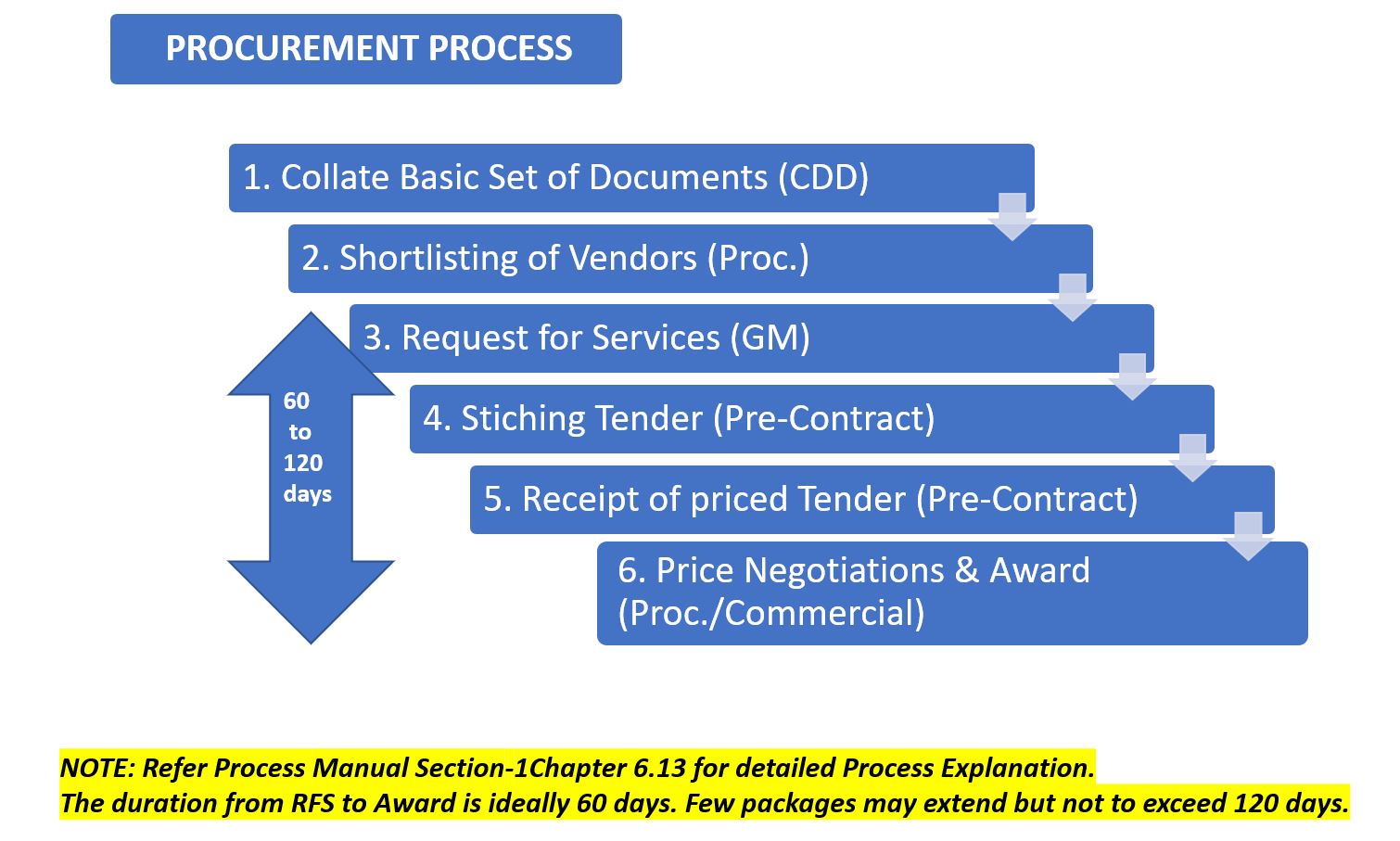
The following process shall be adopted for the Tendering process (Rule 6.27)
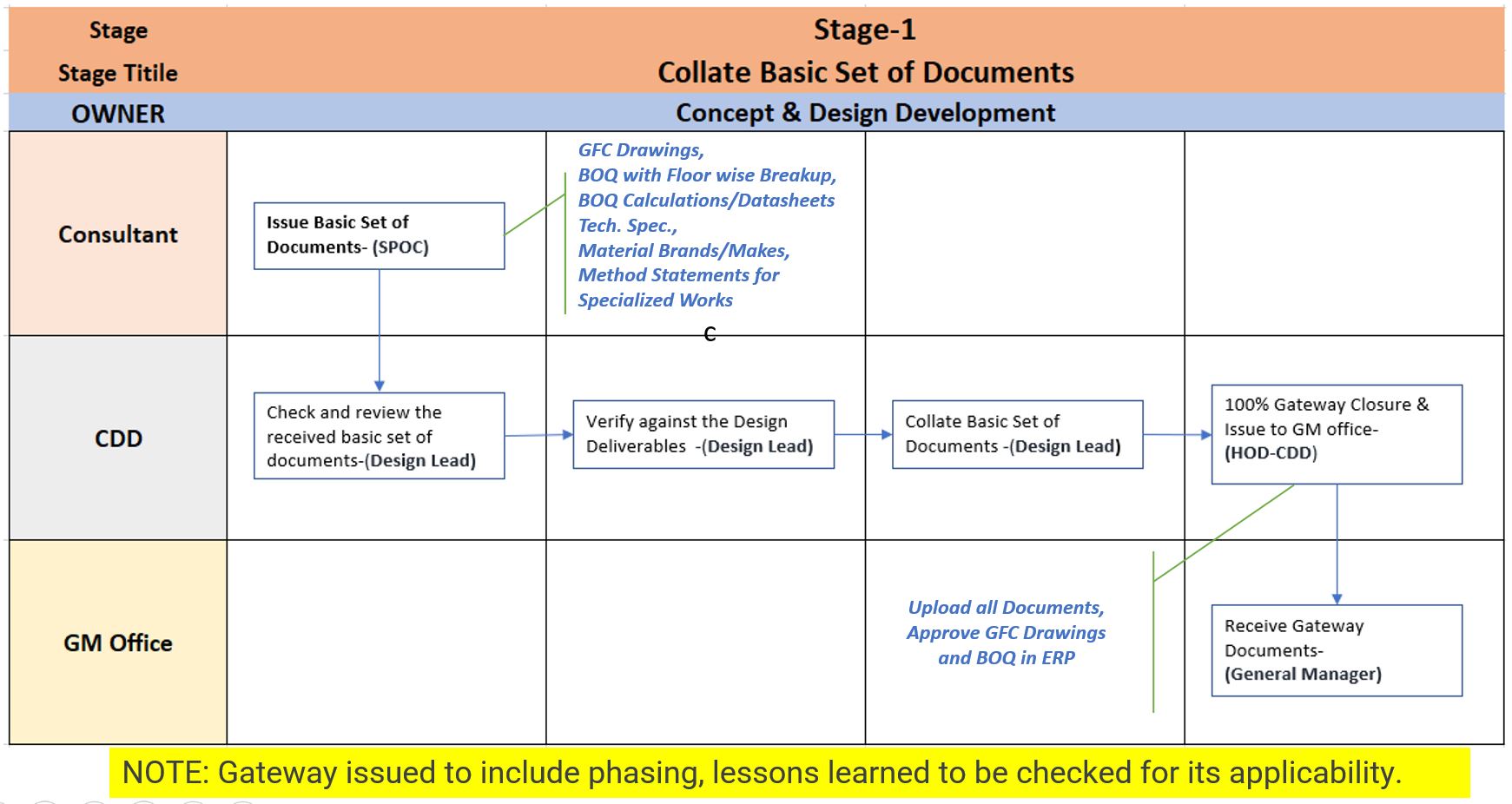
Stage 1: Collating basic set of documents
(a) Tender drawings for the Work,
(b) Bill of Quantities (BOQ)
(c) Technical specifications for the Work & Material selection (preferred brands) and
(d) Method statements
All these are highly interrelated. Method statements should be prepared and annexed with the Technical specifications if the Work is of specialised nature or the consultants require the Contractor to adopt a particular sequence for execution including provision of mock-ups where required. Along with the BOQ, the consultant should be insisted upon to share the calculation sheets/data sheets behind the BOQ. As part of the Development Plan, it is the responsibility of the CDD to get the above documents, do a quick check and attach the same as part of the Gateway documents.
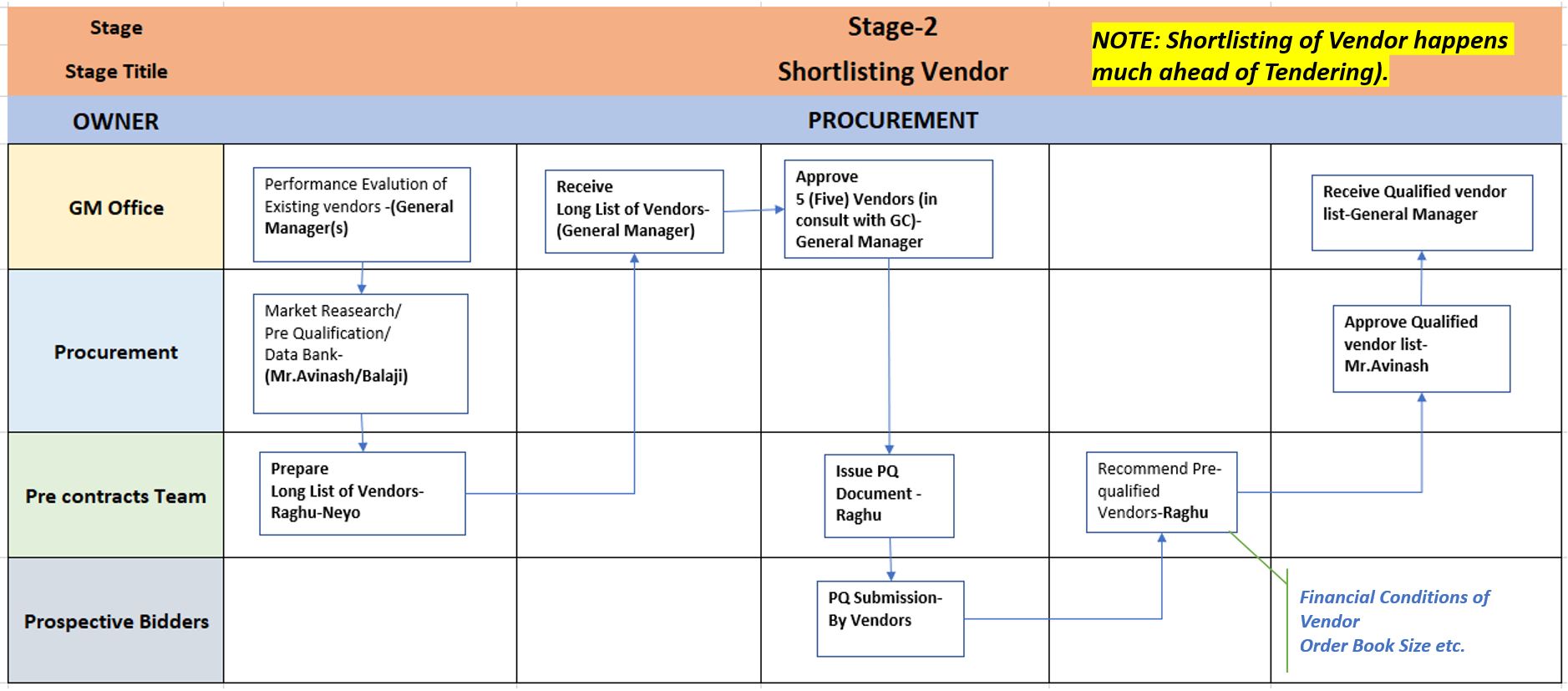
Stage 2: Shortlisting of vendors
- Shortlisting of vendors is done by the Procurement Department much ahead of the tendering process. Shortlisting is done by evaluating certain vendors who are the best in the industry in a particular trade. Performance evaluation done for the existing vendors also to be referred.
- The detailed process of vendor pre-qualification is given in Appendix 11
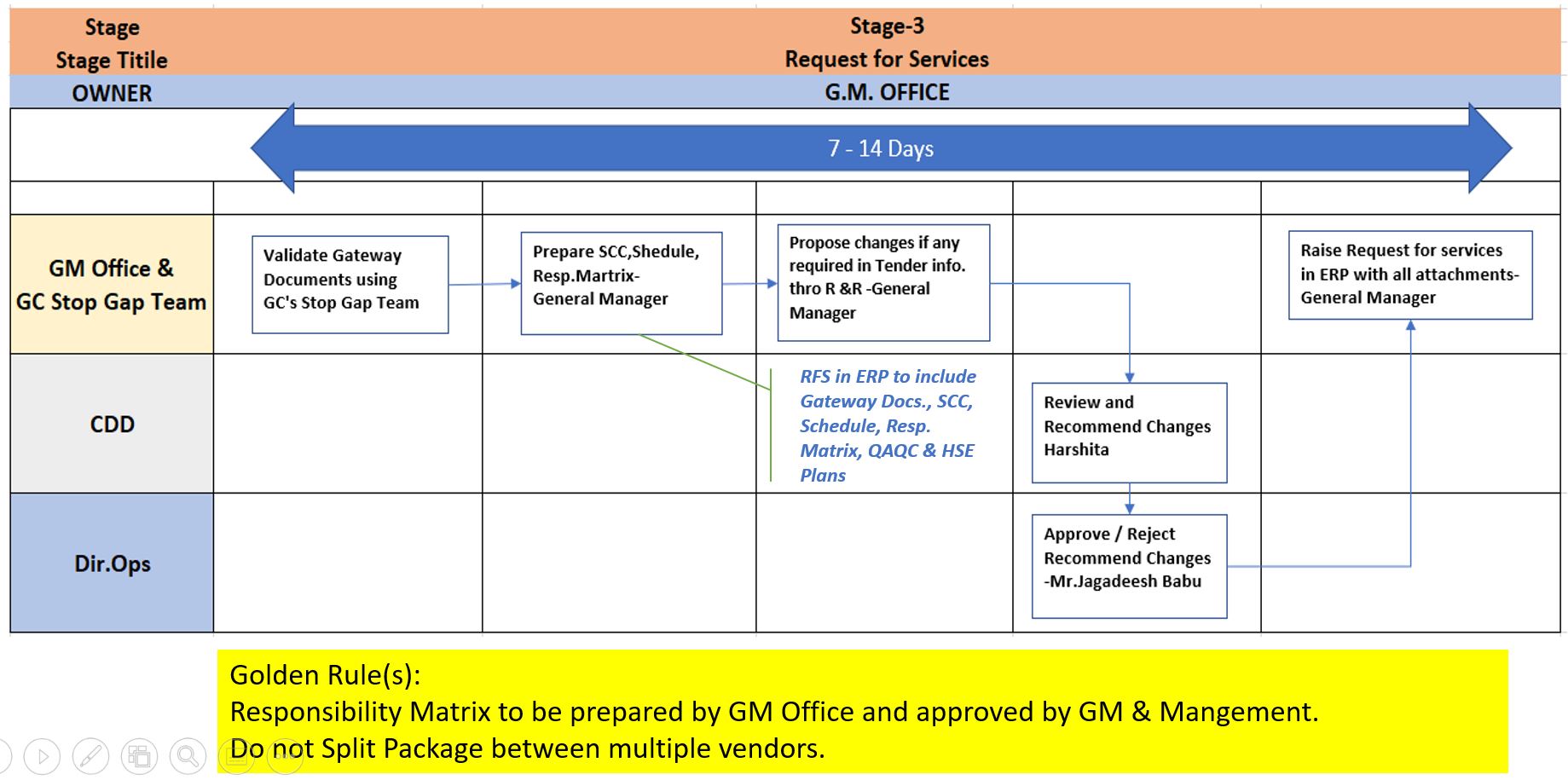
Stage 3: Request for Services (RFS)
-
Every Tender to be floated shall be based on Request for Services issued by the GM office. In case of projects strictly following the Development plan, as the Vendors are selected immediately after selecting the GC, the GM office shall issue RFS sooner the GC is shortlisted. As mentioned, GC shall depute a smaller team to assist the GM office in planning and procurement of vendors (Stop-gap team).
The Request for Services shall be issued as per the form appended herewith in Appendix 12 - The GM office's responsibility is to validate the documents to be attached as part of the RFS which in turn are issued by the CDD as part of the Stage 2 Gateway.
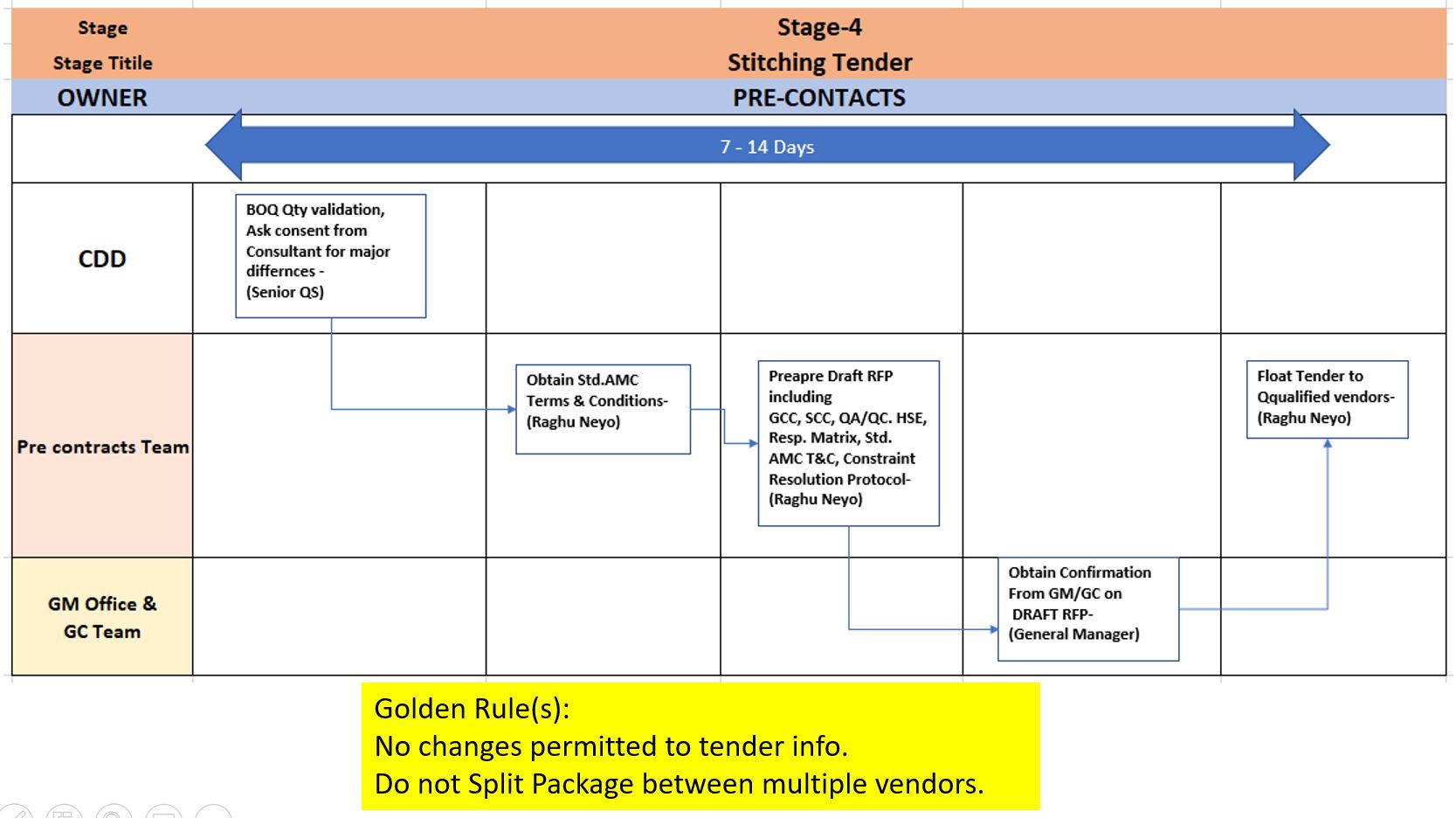
Stage 4: Stitching the Tender
As said, the Tender is a set of documents stitched together for a particular work of the Project. Once the essential documents are received as part of the RFS, the Pre-Contract team shall carry out the following steps;
- Validate the quantities in the BOQ based on the drawings. Towards this, the consultant shall provide the BOQ workings (splitting into the area of work execution) or calculation sheet as part of the delivery.
- As mentioned earlier, in the interest of time, the Tender packages as received can be shared with the bidders with clear remark in the Tender document that the same is under review and validation and the final quantities shall be shared post quantity validation exercise but before start of final rate negotiations. It is the responsibility of the Pre-Contract to confirm the final quantities before the rate negotiation is initiated.
- The Pre contracts team validates the quantities as per their rule book and technicality of the system; however, their final assessment (if different) needs to be shared with the MEP consultant for his consent, prior to confirmation of final quantities. In some cases, this exercise gets lapsed and the awarded BOQ quantities does not match with the Tender BOQ provided by the MEP consultant. Therefore, Pre-contract team need to ensure Consultant approval for major changes in quantities. No changes to specifications given by the Consultant is permitted at the tendering stage.
-
Add
(i) General Conditions of Contract,
(ii) Special Conditions of Contract,
(iii) QAQC plan,
(iv) safety plan and
(v) Responsibility matrix,
from the standard set of documents from the repository of standardised documents unless amended documents provided as part of RFS by the GMs. The milestone/intended schedule should be added as one of the key conditions. - No change to any of the tender information (design, specs, BOQs, method statements, standard GCC, SCC, etc) can be made without the express permission of the CDD and Director Operations. The GCC should contain payment terms not only for the regular banking payment but also the terms and conditions, documents to be submitted, draft LC format etc., if the payment is intended by way of Letter of Credits.
- Share the draft complete Tender with the GM's office for their inputs. The GM's shall, in turn, consult the GC for the correctness of all the packages to be awarded as NSC. It shall be the responsibility of the GC’s on completeness of the Tender and the same need to be clearly stated and confirmed by the GC.
- Post that the Tender shall be floated with the shortlisted vendors by the Pre-Contract Team
- Kindly note that our endeavour is to make the GC responsible for the above Tendering process such that they take the wholistic responsibility and the GM office acts as validator. However, as of now, we are yet to reach that stage and steps (a) to (e) to be followed until further instructions.
- It should be our endeavour to include Annual Maintenance Contract as part of the package for all mechanical installations. The Pre-contract should seek standard terms and conditions from the FM team for AMC, prior to floating the tender and include the same as part of the tender document.
- The Constraints Resolution Protocol (CRP) concept need to be included in the bid and the contract such that the Contractor is obligated to notify constraints & issues for an early response & resolution.
Stage 5: Receipt of priced Tender
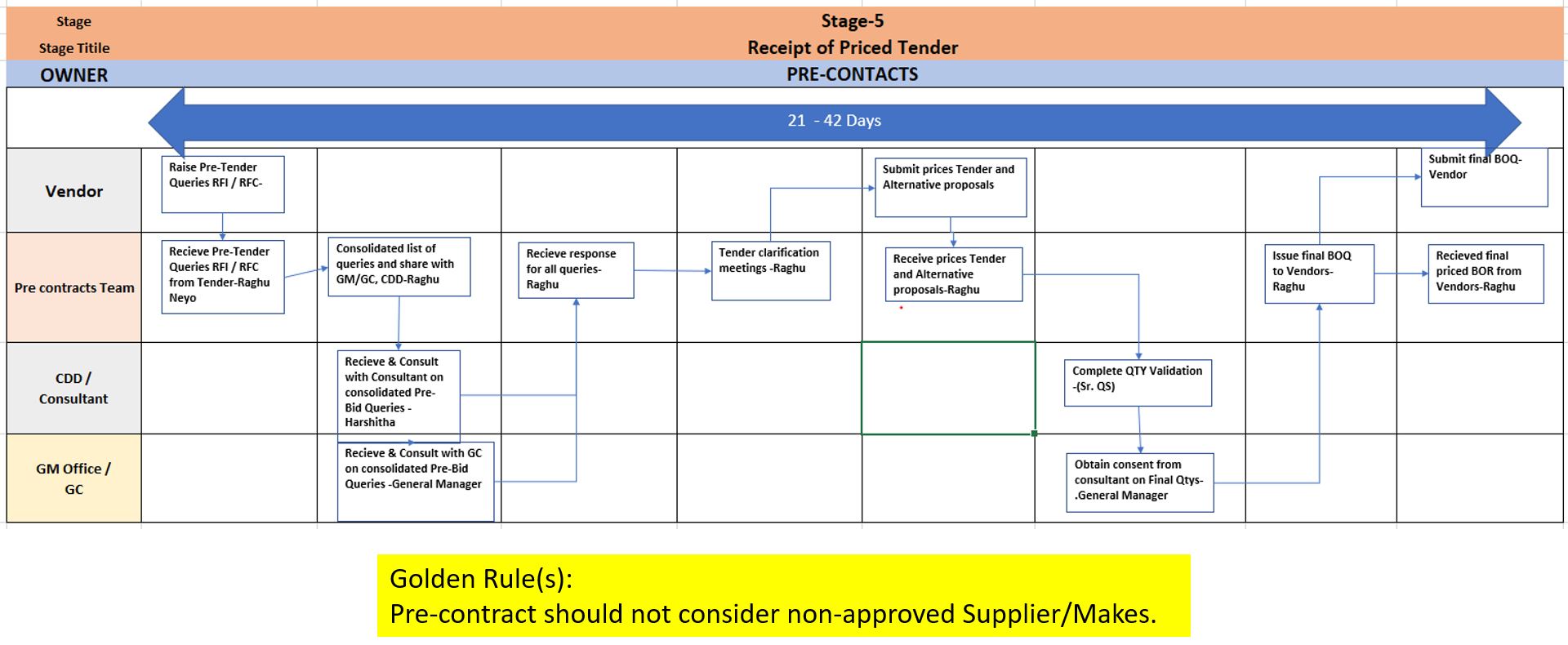
- Post issue of Tender, there shall be many requests for information and clarifications on the Tender released. The Pre-Contract Team's responsibility is to organise a Tender clarification meeting along with GC Team, consolidate all the queries, and liaise with the CDD & GM office to seek answers /provide the clarifications.
- The bidders are expected to price the Bid strictly based on the Tender document. Having priced the Bid as per the Tender document, bidders can also provide annexures to state the value engineering or alternate proposals with variation in the bid price, which shall be considered an additional offer. Phoenix is not obligated to accept the same.
- The Alternate proposals from the vendor should be in line with the approved make suggested by the Consultant. The Pre-Contract team shall ensure that the vendor does not submit any non-certified supplier, just to save some cost and if they do so, the proposal should be rejected.
- Pre contracts team should not approve any supplier/makes, which is not included in the approved make list of the consultant. If the price quoted is for a non-approved supplier, and when the TDS is submitted for the consultant approval, they reject the offer and thus ends up in delay for the approvals and hence the project gets delayed.
- All variation proposals need to be approved by the Consultant prior to finalization of vendors.
Stage 6: Price Negotiations and Award of Contract
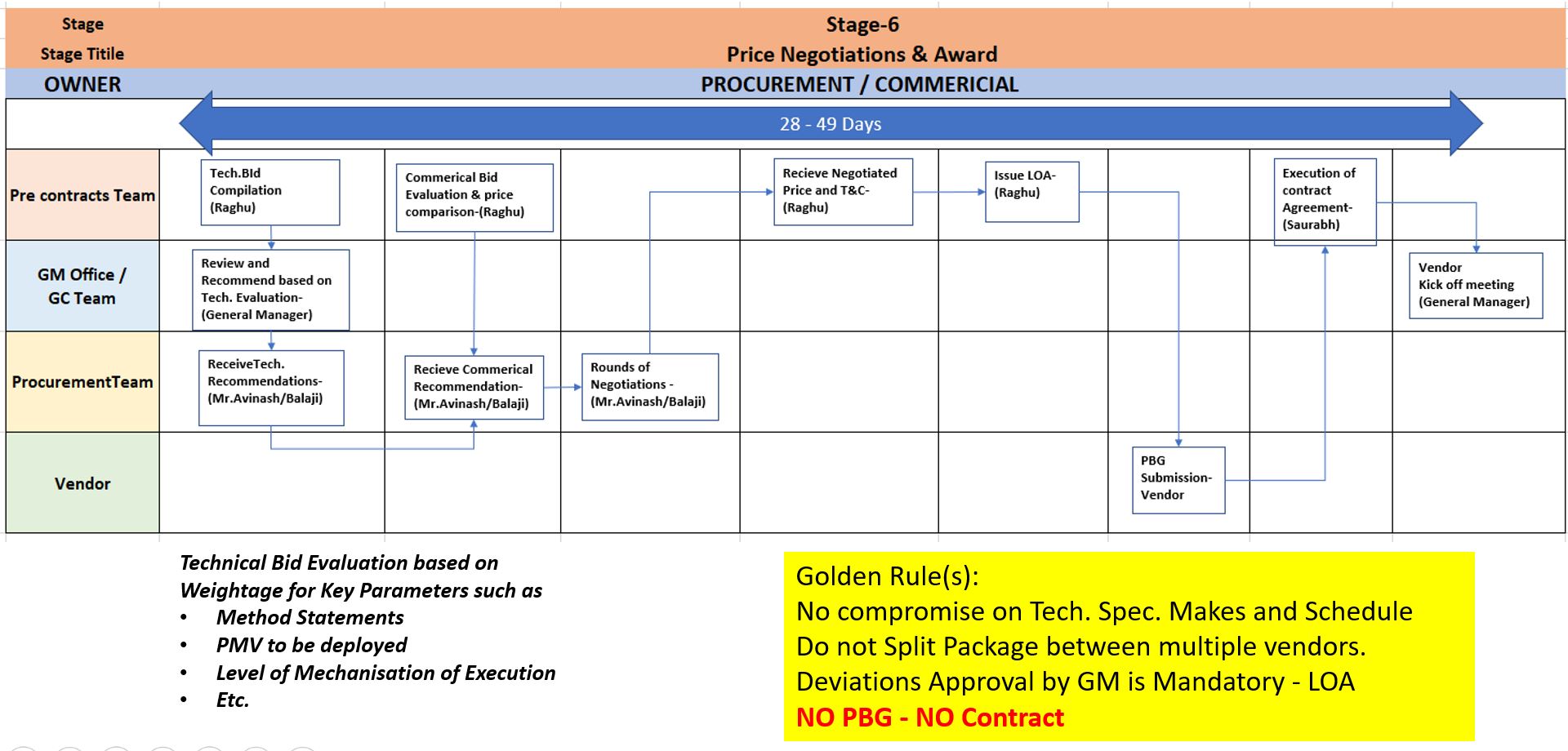
- Once we reach Stage 6, NO changes in the Tender Documents terms and conditions shall be permitted.
-
All bids shall be evaluated based on weightage for key parameters such as
Method statements,
PMV to be deployed,
level of mechanisation of execution,
financial conditions of the vendors,
Order book size, etc.
This shall be developed and presented by the PMO to the procurement department. - The price comparison chart shall be prepared by the Pre-contract team and presented to the Procurement Team for further negotiations.
- These negotiations will be held one on one basis. It is encouraged to involve the GC and GM office in the initial stages of the negotiations to ensure there are no gaps in understanding. No compromise on technical specifications and timeline shall be made for achieving lower price.
- Once the price is negotiated the short-listed Contractor shall be asked to submit the final Bid with the agreed price.
- Only time-bound LOA will be issued in stage 1, and within the time stated, the Bidder has to provide the PBG and only after that Contract will be executed. However, it can be simultaneous and done on the same day but in the same sequence. If they fail to provide the PBG within the stipulated time, the LOI will expire unless extended. It is Director procurement’s prerogative to extend the LOI or let it expire and seek for another vendor.
- After execution of Contract, there shall be onboarding meeting with the Vendor where GC team will brief the vendors about the Project, progress, status as on date and discuss all the key terms of the Contract including the CRP.
- Such a meeting should be attended by the Pre-contract representative, GC Team and Procurement Team. The Contractor will get the opportunity to know the people and seek clarifications if any. Contractor shall present their execution plans.
- This step completes the handholding and handover of the Vendor to the project team.
- The GC shall circulate the Project Directory and Communication Protocol along with the MoM of the kick off meeting.
- Amendments to Contracts has been covered in separate section under Construction Management.
Rule 6.28
Following best practices shall be adopted for Tendering (Rule 6.28)
- In a best-case scenario, we should endeavour to identify the Preferred Vendor even before closure of design as part of the Gateway. We should finetune this process as we move into implementation of the Process Manual. The advantage of this strategy being using the vendors expertise to enhance the design in terms of buildability and time. If required PCSA (Pre-construction service agreement with fee) can be executed with these preferred vendors with no obligation of awarding the contract. The advantages of this strategy are;
- Early contractor involvement to input on design, programme, buildability, commissioning and thus reduce the risks/constraints at the execution stage.
- Facilitate early commencement of site works.
- Maximise cost certainty and avoid cost increases during construction.
- Reduced overall programme duration.
- Improved value engineering input and optioneering.
- Possibility of transferring a greater degree of design and other construction risk to the contractor.
- All the bidders should submit Method Statements for the key works as part of the bids which shall be reviewed by the LDC and approved by the GM/Construction Manager, post award of Contract.
- The Procurement department shall take care to identity experienced vendors from the market who have the abilities to carry out the trades for which they have been chosen.
- Vendor shortlisting or pre-qualification (PQ) is done using the specific checklist refer to Appendix 13 and evaluating the Vendor for various volumes of Work. Certain vendors, in a particular category, may be eligible for a certain volume of Work only. This is determined based on the past experience of the Vendor with a similar volume of Work. By experience and logic, a vendor can perform not more than 1.3X of his previous year turnover, and one has to be cognisance of their order book. Also, a vendor cannot execute an order size of more than 1.3x of the largest order achieved in the last three years. Capacity building happens over a period, and we cannot let the Vendor take the Work out of greed and struggle to perform, which in turn will affect the Project. The person evaluating the Vendor needs to make sure adequate working capital facilities from banks are freely available with the Vendor to execute our project work. If we check the last year turnover, current order book, and we can assess the quantum of bandwidth available to take up our project work in terms of the organisation's capacity and working capital facility.
- Sixty days is required from the date of receipt of the request (Request for services) for the closure of packages with relevant information to the award of Contract. The GM office has to keep this timeline into consideration while planning.
- The above assumes that the required information as per RFS are provided on day 0, and queries are resolved in time.
- Any RFI raised by the Bidder's needs be resolved by CDD/ Consultant / GM office within seven days.
- The 60 days' time is required for the award of Contract refer to Appendix 14 for the flowchart) and post that there shall be one kick-off meeting between the pre-contract, GM office, and Vendor.
- Getting the Vendor started at site post-award of Contract shall lie with GM office.
- Any changes and amendment in contract post-award of Contract shall have to be handled by GM office with the help of Commercial and Legal department, not through Pre-contract
- Performance and Mobilisation BG as per Schedule 1 of GCC template is mandatory for everyone. No exclusions or concessions on this. Should the Vendor not keen to take mobilisation advance due to lack of BG limits, proper evaluation has to be done as to how he shall manage the funding required and without evaluation and assessment, such vendors should not be awarded the Contract. Only Group CEO will have powers to deviate this condition. No PBG- No contract shall be the Mantra.
- Any package involving payment through Letter of Credit shall have the form of Letter of Credit along with intended documents for negotiations of the LC through the bank need to be pre-agreed with the Vendor with clear time lines of opening of LC, as part of the Tender document and LOA/Contract. Only the negotiating banks can make suggestions complying to RBI norms or based on their internal practices. The Client and Contractors cannot change the LC terms once agreed in the Contract. Since LC opening could at time a time consuming process, a interest free security deposit can be provided upto 2% of the LC value (where it is necessary) such that the Contractor starts working on the Project pending opening of LC.
- All the price negotiation will have to be a function of responsibility matrix. No exclusions/deviations to responsibility matrix should be permitted. Any deviations would require consultation and adjustment of budgets hence to be avoided. Should the final contracted price is higher than the gateway budget, R&R to be made by the pre-contract team and submitted to CDD & Director Projects for approval. Post closure of packages, the Budget shall be suitably amended.
- The Tender clarification meeting should have representation from GC, GM office and CDD such that all the initial set of queries can be addressed together. This meeting can be done one on one with each prospective Bidder or collectively with everyone. The minutes of all such meetings (queries raised, and answers provided) should be shared with all the bidders (without identifying who raised the query).
- The CDD and GM office should provide all the necessary support in providing the clarification and information which might require further coordination with the consultants. The tur around time for providing clarifications shall not be more than seven days from the time of raising RFI.
- Under no circumstances, the scope/specifications in the Tender shall be changed by the Pre-Contract Team. Any unavoidable change due to error or executability would require written confirmation by CDD by way of Review & Recommendation for change in the Gateway documents.
- No bidder would be permitted to bid with terms and conditions in addition to what is stated in the bid document. Any deviations to the tender document would make the priced Bid as void, including disqualification. So, the bidders need to be clearly informed of the same as part of the Tender document.
- Bidders are not permitted to change any design and will have to submit the Bid as per the Tender. However, they may annexe a proposal separately for value addition in the Design that Phoenix may (but not obligated) consider if they find it suitable & beneficial. The butterfly effect (impact on other packages) has to be minimum or negligible. If accepted, the change will have to go through the R&R process with additional approval of the change in design by the CDD team. It is the prerogative of the CDD team to accept such proposals.
- All bids will have to be clean bids with no footnotes or remarks. No letters or exclusions by way of a side letter. Deviations if any (subject to approval by Group CEO) should be part of the contract document and not otherwise.
- GCC will not be amended in each case under any circumstances. It shall be a pre-printed document. Any change in GCC conditions (subject to Group CEO approval) shall be only through amending the Special Conditions.
- No bidder will be permitted to touch the wordings given in the BOQ or add footnotes to that. Priced BOQ should match exactly with the Tender BOQ. Pre-contract shall use BOT to match the wordings, and any deviation will make the tender invalid.
- The contract document's negotiation shall have to be done even before the finalisation of price as part of Tender document evaluation. No change in the contract document will be entertained post issue of LOA.
However, care should be taken not to introduce changes/improvements in design which meet the Contractor’s unique requirements or those which cannot be used by other vendors. The changes / improvements proposed by the preferred vendors should be project centric and neutral to all vendors.
Rule 6.29
Following Seven Golden Rules shall be strictly followed for Tendering & Award of Contracts (Rule 6.29)
- PQ of vendors is mandatory based on type & complexity of packages. On request, Pre contract shall share the list of names meeting the package requirement and GM to approve 5 names (minimum 3) from the list. Once selected by GM, they should be indifferent to all of them. This will help PD get best price at the time of negotiation. Rejection of vendors should be at the time of selection of names and not after floating tender. GM can take inputs from GC on the names, if they are already onboard.
- GM’s request for services (RFS) must be clear and follow standard package list and responsibility matrix. It should include the schedule, quality, safety, gateway tender package drawings, special conditions, technical specs, brands & makes, responsibility matrix (standard) and other special requirements. More the clarity in RFS, better will be the clarity in contract and final bid value.
- Responsibility Matrix - Once set and agreed as standard, no deviations can be done by anyone. Any deviation in Responsibility Matrix to be treated as significant and require approval from GM and management. No deviations in responsibility matrix to achieve better pricing at the time of negotiation. It should be sacrosanct and rigid.
- Tech and Financial evaluation - to be shared and presented to the GM once concluded (atleast the best 3). This should be done before Pre-contract conform with the short listed vendor. Pushback by GM will be only on merits and credible reasons as to why L2 is better than L1.
- LoA draft to be shared with GM , and inclusive of statements on deviation / non-compliance with RFS. LOA should be in line with RFS and deviations need to be approved by GM. It is mandatory.
- No Changes in Standard Contract terms, Standard Responsibility Matrix and RFS sent by GMs.
- Not Contract package to be split into elements, it must be all inclusive of supply, install and test & commissioning responsibilities. Do not split the responsibility between multiple vendors. It never adds up. Package should be with comprehensive responsibility of a single vendor. Any sub vendors (for scope not done by main vendor) should be assumed by the main vendor on day one as sub-contractor, with no dependency on Phoenix.
The completion of the above tasks represents the completion of Stage C of the Development plan. Tasks such as Municipal approval, SDA, Debt syndication and Shop Drawing approval of NSC have not been considered for process detailing for now, as they are technical in nature.
Now we shall discuss the tasks involved in Stage D of the Development Plan.
Back to Top